
Overview
Consistent with state law and System Policy 12.04, the Faculty Advisory Council (FAC) is intended to provide direct input to leadership in a manner that is transparent, forward-looking, and aligned with the priorities and mission of Texas A&M University. Based on the guidance outlined in University Rule 12.04.99.M1, the following information outlines the election process and apportionment of faculty seats by college/school for the initial seating process.
Initial Seating Timeline
SEATING PROCESS
The seating process will run from February through April as outlined in the following high-level timeline:
February:
- The nomination process for all colleges and schools runs for a minimum of two weeks through InfoReady, an online platform that facilitates applications. Please note that faculty will receive a direct email from InfoReady to their NetID email (tamu.edu email address) with a link to nominate. Nominees may self-nominate or nominate another faculty member within their college or school. Anyone nominated will be asked to confirm their willingness to serve as part of the nomination process through InfoReady.
- Following the nomination process, Interim President Tommy Williams will appoint one faculty member per college and school from the nominations or more broadly across the faculty to serve on the FAC in accordance with the university rule.
- After presidential appointments are announced, faculty will vote on faculty representatives from their college or school to fill the remaining seats based on the initial set of nominees, excluding any presidential appointments.
- Following the election by faculty, faculty will self-nominate or nominate individuals from their college or school’s elected and appointed FAC members for FAC leadership positions.
- The Interim President Williams will use these nominations to appoint FAC leadership positions.
- Following the seating of the FAC and its leadership, FAC members will prepare necessary organizing documentation that will be reviewed, discussed and approved at their initial meeting in September, supporting a strong start to the FAC in fiscal year 2027.
Seats by College/School
| College/School | Appointed Seats | Elected Seats one-year | Elected Seats two-year | Total Seats |
|---|---|---|---|---|
| College of Agriculture and Life Sciences | 1 | 2 | 2 | 5 |
| College of Architecture | 1 | 1 | 0 | 2 |
| College of Arts & Sciences | 1 | 6 | 5 | 12 |
| Bush School of Government and Public Service | 1 | 1 | 0 | 2 |
| College of Engineering | 1 | 5 | 5 | 11 |
| School of Engineering Medicine | 1 | 1 | 0 | 2 |
| School of Law | 1 | 0 | 1 | 2 |
| Mays Business School | 1 | 1 | 1 | 3 |
| College of Marine Sciences & Maritime Studies | 1 | 1 | 0 | 2 |
| Irma Lerma Rangel College of Pharmacy | 1 | 0 | 1 | 2 |
| College of Performance, Visualization & Fine Arts | 1 | 0 | 1 | 2 |
| College of Education and Human Development | 1 | 1 | 1 | 3 |
| College of Dentistry | 1 | 0 | 1 | 2 |
| Naresh K. Vashisht College of Medicine | 1 | 1 | 1 | 3 |
| College of Nursing | 1 | 0 | 1 | 2 |
| School of Public Health | 1 | 1 | 0 | 2 |
| College of Veterinary Medicine & Biomedical Sciences | 1 | 1 | 1 | 3 |
Council Member Terms
FAC members elected by the faculty serve a staggered two-year term and cannot serve consecutive terms. An elected representative is not eligible to serve a subsequent term until two years after the expiration of the member’s most recent term. Faculty are seated either by presidential appointment or election from their college or school, and terms run from Sept. 1 to Aug. 31. In the inaugural year of the Faculty Advisory Council, in order to have approximately one-half of the elected representatives elected each year in the future, one-half of the elected representatives in the first year will be elected to a one-year term rather than a two-year term, based on the following formula:
- In a college or school with more than two total (elected and appointed) representatives, up to half of the faculty representatives who were elected but received less votes will serve a one-year term.
- In a college or school with two total (elected and appointed) representatives, up to half of these colleges or schools, will have their initial elected faculty representative serve a one-year term.
Based on the formula above, the initial one- and two-year terms will be randomly assigned by the FAC.
A FAC member appointed by the President may serve up to six consecutive one-year terms and then may only be reappointed two years after the expiration of the member's most recent term.
Faculty Advisory Council Apportionment
As specified in Texas A&M University Rule 12.04.99.M1, the FAC will be reapportioned every four years. Furthermore, Texas A&M System Policy 12.04 Faculty Advisor Council allows for the establishment of a Faculty Advisory Council at the University starting on November 1st, 2025. The apportionment detailed in this document describes the initial apportionment of the Texas A&M University Faculty Advisory Council undertaken during the Fall 2025 Semester.
The following three documents guide this apportionment process:
- Texas Senate Bill 37 (89th Legislature, 2025-2026): Texas Senate Bill 37 Sec. 51.3522 “requires the members to be faculty members; and except as otherwise provided by the governing board, limits the number of members to not more than 60 with at least two representatives from each college or school, including: one member appointed by the president or chief executive officer of the institution; and the remaining members elected by a vote of the faculty of the member ’s respective college or school.”
- Texas A&M System 12.04 Faculty Advisory Council: Texas A&M System Policy 12.04 codifies Senate Bill 37 regulations for Faculty Advisory Councils within the Texas A&M University System and further stipulates that for institutions with more than 600 Full Time Equivalent Faculty (FTE), which includes Texas A&M University, the number of members comprising the Faculty Advisory Council will not exceed 60.
- Texas A&M University SAP 12.04.99.M1: Section 4 of the Texas A&M University SAP 12.04.99.M1, specifies the apportionment of the newly formed FAC. Pertinent to this apportionment, include the requirement for a minimum of two faculty from each college or school, one of which will be appointed by the President while the remainder will be elected. The SAP specifies that apportionment will be based on the method of equal proportions as used by the United States House of Representatives which is described at the methods section.
Understanding Texas A&M Faculty Representation
As specified in Section 4.4 of the rule, the faculty count used in the apportionment must be determined using the following formula:
- Each full-time equivalent faculty member will be counted as one
- Each part-time faculty member will be counted based on their percent effort using the standard appointment period for respective faculty in their college or school.
Per Section 4.5 of the Texas A&M SAP 12.04.09, the numbers of Texas A&M Faculty used in the apportionment will be based the University payroll for November of the year of reapportionment and will occur in December of every fourth year.
This apportionment meets these requirements by basing the apportionment on information on Faculty numbers provided by Michelle Mitchell, Assistant Vice President & Chief Data Management Officer, Strategy & Business Services. These faculty numbers were pulled on Nov. 1, 2025, which is the month end payroll for October and represents the University’s Faculty Census Date. Faculty information from this date serves as the basis for other Texas A&M faculty reporting.
The data provided (detailed in Table 1) provides the FTE for full- and part-time faculty for individual colleges/schools as specified in Section 4.4 of University SAP 12.04.99.M1. FTE counts were provided separately for Tenure/Tenure Track (TTF) and Academic Professional Track (APT) Faculty to provide greater transparency on the breakdown of faculty FTEs.
number of seats includes the initial two seats plus any apportioned seats.The apportionment was performed using the Python script provided in Appendix 1. The processing was performed using Python version 3.9.12 and the standard Numpy (version 1.21.5) and Pandas (version 1.4.2) libraries. The script was tested against the 2023 Faculty Senate Reapportionment results to ensure it performed correctly. The results of this apportionment were independently verified by Dr. Janice Epstein, Emeritus Professor in Mathematics, who has previously reapportioned the Texas A&M Faculty Senate.
ResultsThe results of the Python-based apportionment are described in Table 2 and illustrated in Figure 1. Overall, with a Faculty FTE total of 3871.39 and a total of 60 members the quota is 3871.39/60 = 65.52. Roughly speaking this means that ideally for each college or school there should be one member for approximately 66 FTEs.Table 2 lists the number of seats apportioned to each college as well as the number of total seats that were either appointed or elected. The table also indicates the FTE / Member ratio for each college or school. These results are also shown graphically in Figure 1.
| College | Unit | APT FT | APT PT | APT Total | TTF FT | TTF PT | TTF Total | Grand Total |
|---|---|---|---|---|---|---|---|---|
| Bush School of Government and Public Service | BUSH | 34 | 15.45 | 49.45 | 75 | 0.00 | 75.00 | 124.45 |
| College of Agriculture and Life Sciences | AGLS | 95 | 9.37 | 104.37 | 287 | 0.00 | 287.00 | 391.37 |
| College of Architecture | ARCH | 68 | 8.73 | 76.73 | 66 | 1.60 | 67.60 | 144.33 |
| College of Arts & Sciences | ARTSCI | 287 | 9.47 | 296.47 | 555 | 14.52 | 569.52 | 865.99 |
| College of Dentistry | SOD | 91 | 28.57 | 119.57 | 28 | 0.50 | 28.50 | 148.07 |
| College of Education and Human Development | SEHD | 108 | 11.21 | 119.21 | 127 | 0.00 | 127.00 | 246.21 |
| College of Engineering | COE | 235 | 35.48 | 270.48 | 494 | 4.36 | 498.36 | 768.84 |
| College of Marine Sciences & Maritime Studies | MSMS | 64 | 5.04 | 69.04 | 54 | 0.00 | 54.00 | 123.04 |
| Naresh K. Vashisht College of Medicine | SOM | 119 | 8.34 | 127.34 | 77 | 0.00 | 77.00 | 204.34 |
| College of Nursing | SON | 40 | 10.67 | 50.67 | 12 | 0.00 | 12.00 | 62.67 |
| College of Performance, Visualization & Fine Arts | PVFA | 52 | 2.82 | 54.82 | 48 | 0.00 | 48.00 | 102.82 |
| College of Veterinary Medicine & Biomedical Sciences | VBMS | 119 | 1.95 | 120.95 | 101 | 0.70 | 101.70 | 222.65 |
| Irma Lerma Rangel College of Pharmacy | PHAR | 26 | 1.69 | 27.69 | 19 | 0.00 | 19.00 | 46.69 |
| Mays Business School | MAYS | 78 | 10.79 | 88.79 | 118 | 0.50 | 118.50 | 207.29 |
| School of Engineering Medicine | ENMED | 20 | 1.00 | 21.00 | 2 | 0.00 | 2.00 | 23.00 |
| School of Law | LAW | 20 | 21.74 | 41.74 | 46 | 0.18 | 46.18 | 87.92 |
| School of Public Health | SOPH | 36 | 3.71 | 39.71 | 62 | 0.00 | 62.00 | 101.71 |
| College/School | Unit | Apportioned Seats | Appointed Seats | Elected Seats | Total Seats | FTE / Member Ratio | ||
| College of Agriculture and Life Sciences | AGLS | 3 | 1 | 4 | 5 | 78.27 | ||
| College of Architecture | ARCH | 0 | 1 | 1 | 2 | 72.16 | ||
| College of Arts & Sciences | ARTSCI | 10 | 1 | 11 | 12 | 72.17 | ||
| Bush School of Government and Public Service | BUSH | 0 | 1 | 1 | 2 | 62.23 | ||
| College of Engineering | COE | 9 | 1 | 10 | 11 | 69.89 | ||
| School of Engineering Medicine | ENMED | 0 | 1 | 1 | 2 | 11.50 | ||
| School of Law | LAW | 0 | 1 | 1 | 2 | 43.96 | ||
| Mays Business School | MAYS | 1 | 1 | 2 | 3 | 69.10 | ||
| College of Marine Sciences & Maritime Studies | MSMS | 0 | 1 | 1 | 2 | 61.52 | ||
| Irma Lerma Rangel College of Pharmacy | PHAR | 0 | 1 | 1 | 2 | 23.35 | ||
| College of Performance, Visualization & Fine Arts | PVFA | 0 | 1 | 1 | 2 | 51.41 | ||
| College of Education and Human Development | SEHD | 1 | 1 | 2 | 3 | 82.07 | ||
| College of Dentistry | SOD | 0 | 1 | 1 | 2 | 74.04 | ||
| College of Medicine | SOM | 1 | 1 | 2 | 3 | 68.11 | ||
| College of Nursing | SON | 0 | 1 | 1 | 2 | 31.34 | ||
| School of Public Health | SOPH | 0 | 1 | 1 | 2 | 50.86 | ||
| College of Veterinary Medicine & Biomedical Sciences | VMBS | 1 | 1 | 2 | 3 | 74.22 |
Methodology
The equal proportions method employed by the United States House of Representatives, also known as the Huntington-Hill method (Crocker 2010, Schmeckebier 1952, U.S. Census Bureau, n.d.) was used to apportion the sixty seats of the Faculty Advisory Council to the seventeen individual colleges/schools listed in Table 1 adhering to the constraints codified in Senate Bill 37.The first step in the process assigns two seats (one appointed, one elected) to each college/school. This leaves the remaining 26 seats (60 – 17×2 = 26) to be apportioned using the equal proportions method.The advantage of this method is that it minimizes the relative differences in the number of faculty represented by each member in the Faculty Advisory Council. In this method, after the initial allocation of two seats per college/school, the remaining seats are allocated one at a time. Under this method a college/school is allocated an additional seat when the faculty count of that unit divided by the geometric mean of its present assignment and its present assignment as specified in equation (1) is greater than the faculty count of any other unit also divided by the geometric mean.
Where P is the Faculty Count for the College or School and n is the number of seats a unit would have if it gained as seat or in this case as each college/school is already allocated two seats the next possible seat any unit would be allocated would be seat three, and the next seat four until the number of possible seats for allocation is reached (26 in this case).Ignoring the Faculty Count (P) and focusing simply on the multiplier which is the reciprocal of the geometric mean we can see that for the third seat the multiplier becomes: and the multiplier for the fourth seat becomes yet smaller as:
 Once a sufficient set of multipliers has been computed, which in this exercise conservatively extended to n = 26, this set is then multiplied by the Faculty Count (P) for each college or school. This resulting set of numbers are the priority values.
These priority values are then ranked starting with seat 35 as each of the 17 colleges/schools was initially allotted 2 seats and continuing until all 60 seats have been assigned based on the top 26 priority numbers in decreasing order. The number of apportioned seats within these top 26 is then tallied for each college/school. The total number of seats includes the initial two seats plus any apportioned seats.
The apportionment was performed using the Python script provided in Appendix 1. The processing was performed using Python version 3.9.12 and the standard Numpy (version 1.21.5) and Pandas (version 1.4.2) libraries. The script was tested against the 2023 Faculty Senate Reapportionment results to ensure it performed correctly. The results of this apportionment were independently verified by Dr. Janice Epstein, Emeritus Professor in Mathematics, who has previously reapportioned the Texas A&M Faculty Senate.
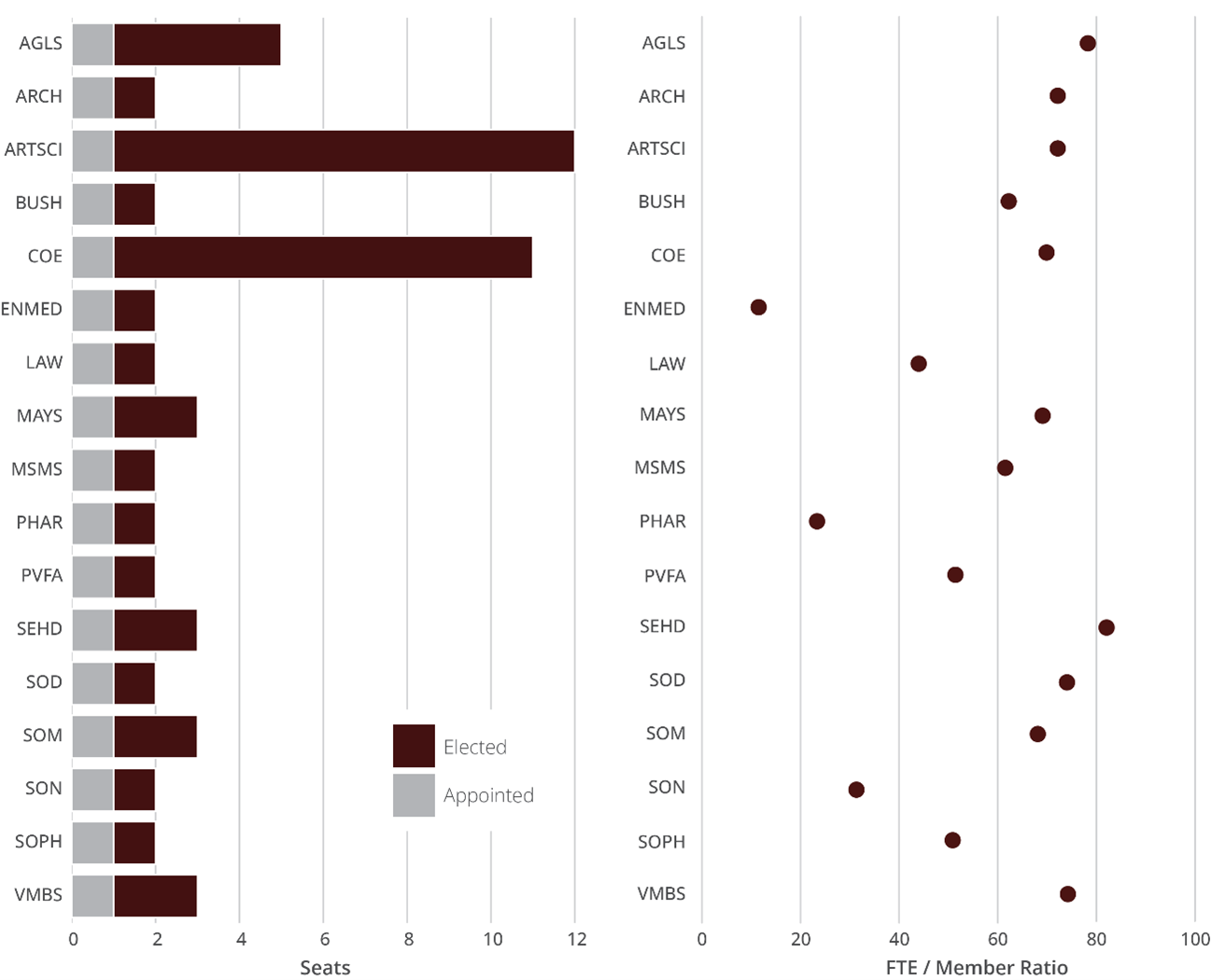
Figure 1
Overall, in addition to the single appointed seat for each unit ten of the seventeen units have a single elected seat, four units have two elected seats, and three units have more than two elected seats. For the majority of the units (10) the FTE / Member ratio falls in the range between 60 and 80. Three of the smaller colleges and schools have FTE / Member ratios lower than 40 while one – the College of Education and Human Development has a ratio that slightly exceeds 80 (82.07).
References
Crocker, R., 2010. The US House of Representatives apportionment formula in theory and practice. Congressional Research Service (7-5700), 27 pp.
Schmeckebier, L.F., 1952. The method of equal proportions. Law and Contemporary Problems, 17(2), pp.302-313
U.S. Census Bureau (n.d.) About Congressional Apportionment. Available at: https://www.census.gov/topics/public-sector/congressional-apportionment/about.html (Accessed: 11 November 2025)